
Have you ever wondered what birds are actually saying to each other?
In Japan, there is a small bird that might give you an answer. It’s the Japanese Tit, called shijukara (シジュウカラ) in Japanese.
Scientists have found that this bird uses different calls like words. And it puts them together into sentences, following grammar rules.
Hi, I’m Haru from Isohiyo Note. The Japanese Tit was one of the very first birds I learned to recognize when I started birdwatching. Today, let me introduce this tiny talking bird.

✨ A little bird in a black necktie
The Japanese Tit has a glossy black head and round white cheeks. Its back is a soft yellowish green.
And down the middle of its chest runs a black stripe, just like a necktie. That’s the easiest way to recognize it.
It’s about 15 cm (6 inches) long, a little smaller than a House Sparrow. It weighs only about 15 grams. That’s lighter than an AA battery.
If you know the Great Tit from Europe, it may look familiar. The Japanese Tit was long treated as a type of Great Tit, but today it is usually considered a species of its own.
It lives in Japan all year round, in parks, gardens and forests. In my records, I have met Japanese Tits 249 times, in every single month of the year. 136 of those were at Umami Kyuryo Park in Nara, our home birding spot.
☘ What’s on the menu in winter?
Japanese Tits eat insects, spiders, seeds and berries.
One January day at Umami Kyuryo Park, I watched one catch a bagworm. It held the bagworm down with its feet and tore the case open to get the larva inside.
It looked like hard work!


Another one was pecking at the seeds of Canada goldenrod. Here’s a fun fact for North American readers: this plant came to Japan from your side of the Pacific, and now it grows almost everywhere along roads and rivers.
The seeds looked dry and not tasty at all.

In winter, even food like this is a feast. It showed me how tough winter can be for small birds.
♪ The bird that speaks in sentences
This is the part I most want to tell you.
Toshitaka Suzuki, a Japanese biologist now at the University of Tokyo, has studied Japanese Tits in the wild for more than 17 years. In 2016, he published a surprising discovery. Their calls follow grammar rules.
Here’s how it works. Japanese Tits have a call that sounds like “pee-tsu-pee.” It means “Watch out!” They also have a call like “dee-dee-dee.” It means “Come here!”
Put them together, “pee-tsu-pee, dee-dee-dee,” and it means “Watch out and come here.” Birds that hear it come closer, carefully scanning around them.
But if you reverse the order, “dee-dee-dee, pee-tsu-pee,” the birds hardly react at all. Same words, wrong order, no meaning.
He tested this by playing recordings from a speaker in the forest. I find it amazing that such a tiny bird has something so close to our own language.
His work helped start a new field of science called animal linguistics. In 2024, he and a colleague even reported a gesture. A Japanese Tit flutters its wings to tell its mate “after you” at the nest.
⭐ Different words for different enemies
Japanese Tits have many enemies: hawks, crows and snakes.
Here’s the interesting part. Their alarm call changes depending on the enemy. For a hawk, they call “hee-hee-hee.” For a snake, they call “jar-jar.” Birds that hear “jar-jar” start looking around for a snake.
In autumn and winter, Japanese Tits join mixed flocks with other small birds, like Varied Tits, Long-tailed Tits, Japanese Pygmy Woodpeckers and Warbling White-eyes. The other birds in the flock pay attention to their alarm calls too.
When they find an enemy, Japanese Tits sometimes call their friends and chase it away together. This is called mobbing. I’ve seen small birds ganging up on a crow while birdwatching. A tiny body, but with words, they can be strong.
✏ A quick guide to their calls
Here are the calls you are most likely to hear in a park in Japan.
- Tsu-tsu-pee, tsu-tsu-pee: the song. Males sing it in spring to say “This is my territory.”
- Chi-chi, juku-jiji: everyday calls to keep in touch with friends
- Pee-tsu-pee: “Watch out!”
- Dee-dee-dee: “Come here!”
- Hee-hee-hee: “Hawk!”
- Jar-jar: “Snake!”
Once you learn the song, you’ll know a Japanese Tit is nearby even before you see it.
✨ Telling males from females
Males and females have the same colors, so at first glance they are hard to tell apart.
The secret is the width of the necktie. A male’s necktie is wide and spreads out toward the belly. A female’s is thinner.
This one is a male.

And this fluffy one is a juvenile. Its feathers are messy and its necktie is still pale. Very cute! I took this photo at Umami Kyuryo Park in July 2026.
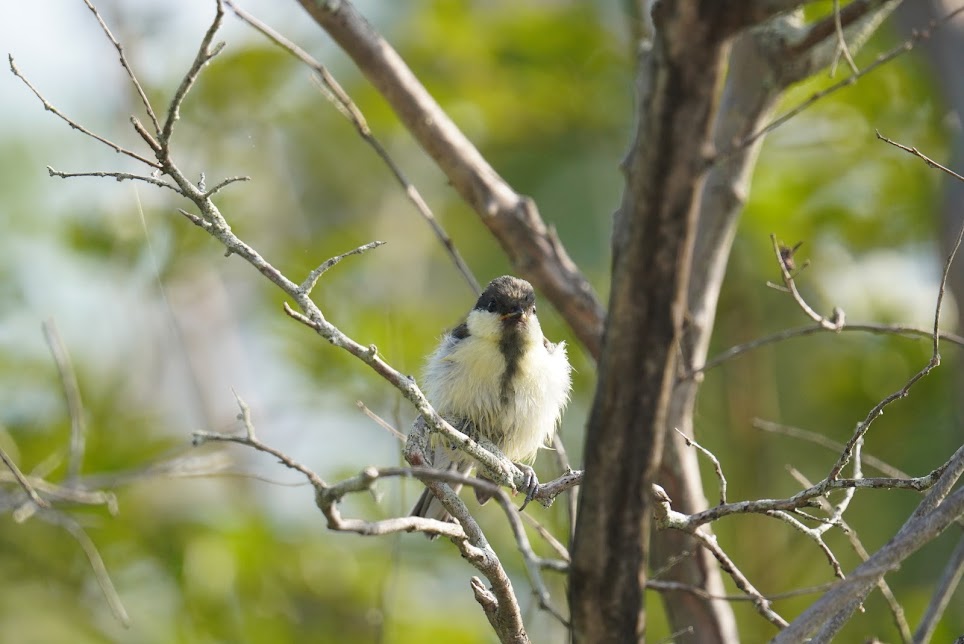
Japanese Tits often nest in nest boxes, too. If you put one in your garden in early spring, a pair might move in.
❓ “Forty” and “Fifty”: a name puzzle
In kanji, the Japanese Tit is written 四十雀. It literally means “forty sparrows.”
Why forty? The most popular theory is that it comes from its call. To people long ago, it sounded like “shi-ju,” which also means forty. An encyclopedia from the Edo period (1600s to 1800s) says the bird seems to sing its own name.
Another theory says it was once worth the price of forty sparrows. No one knows for sure.
And here’s the fun part. Japan also has a bird called 五十雀, “fifty sparrows.” It’s the Eurasian Nuthatch. The names sound alike, but the two birds belong to different families.
The nuthatch has a special trick. It can walk headfirst down a tree trunk. I took this photo in May 2025 near Mt. Wasamata in Nara.

♪ Listen to the little talkers
Fifteen grams, and so many words.
Running from enemies, calling to friends, Japanese Tits are living their busy lives right in the middle of our cities.
If you ever visit a park in Japan and hear “tsu-tsu-pee, tsu-tsu-pee,” stop for a moment and listen. Try to imagine what they’re saying. It makes birdwatching so much more fun.
▶ Blue Rock Thrush in Japan: The Cliff Bird That Moved to the City
*I use AI to help organize and polish the wording of my articles, but all observation records and photos are our own.
